What is the gender pay gap?
The official UK gender pay gap data, collated by the Office for National Statistics, measures the difference between the median hourly pay for men and women, excluding overtime, and measured across all forms of work.
Provisional data for 2024 reveals a UK-wide gender pay gap of 13.1%, down from 14.2% in 2023.
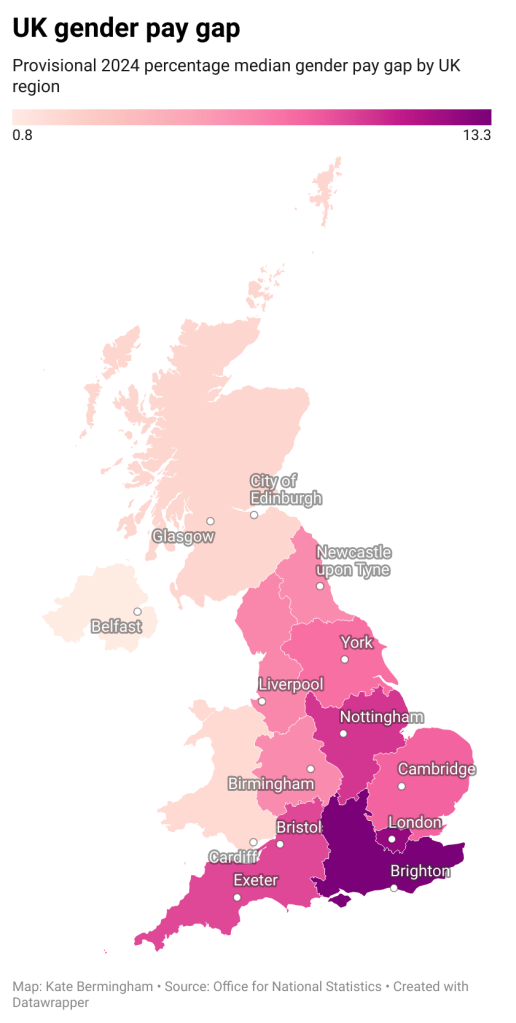
ONS gender pay gap data is not a ‘like for like’ measure of the difference in pay between men and women with similar skills and experience doing the same job. However, it does give an overall view of the pay shortfall that women as a group typically experience.
In the vast majority of cases, women are disadvantaged by the gender pay gap. However, in some circumstances, a ‘reverse’ gender pay gap exists, where the median hourly pay is higher for women than men. For example, in 2024 there was a reverse gender pay gap of -3% for part-time workers.
The 2024 gender pay gap for full-time workers is 7%. The overall gender pay gap is higher than both the full-time and part-time figures due to Simpson’s paradox.
Is the gender pay gap shrinking over time?
Yes, but very slowly. In 1997, the overall gender pay gap in the UK was 27.5%. Now it’s 13.1%. At the current rate of change, the gender pay gap will exist for another quarter of a century.
Why is the gender pay gap so much worse in London and the South East?
London and the South East have the largest regional gender pay gaps: 12.4% and 13.3% respectively. Northern Ireland and Wales have the smallest, at 0.8% and 1.9%.
At the current rate of change, the gender pay gap will exist until 2077 in the South East and 2148 in London.
It’s hard to say exactly why the gender pay gap is so high in these regions, and why it’s taking so long to make progress. However, research suggests the following factors have an impact:
Traditional gender norms
From an early age and throughout their lives, women are often socially conditioned to prioritise family and relationships over their careers. Many women feel discouraged from pursuing highly paid positions or asking for pay rises. Some feel excluded or unwelcome in traditionally male-dominated occupations and industries.
Lack of pay transparency
Unlike the EU, the UK does not have any laws on pay transparency. This means employers are not obliged to disclose information about salaries and criteria for pay progression. Most public and voluntary sector employers typically do publish some salary data (e.g. pay scales on job adverts) but private sector employers are less likely to do so.
Inflexible working conditions
52% of women say a lack of flexibility at work has pushed them to leave or consider leaving a job. Those who do work flexibly are often hit with a loss of working hours or pay.
Gender discrimination
Some employers, consciously or unconsciously, are reluctant to employ and promote women to positions of seniority within their organisation. Two-fifths of female senior managers have been asked if they have children, or if they plan to, during a recruitment process.
Maternity discrimination
Research from Pregnant Then Screwed suggests 12% of working mothers lose their jobs for getting pregnant or taking maternity leave. 49.5% of pregnant women, those on maternity leave, and those returning from maternity leave say they had a negative experience at work.
 Living under Patriarchy