What is the gender wealth gap?
While the gender pay gap measures the difference in income between male and female workers, the gender wealth gap measures the difference in wealth (including savings, investments and assets, such as property) between men and women.
The Women’s Budget Group found a gender wealth gap of 35% in Great Britain, equivalent to a difference in wealth of £92,762.
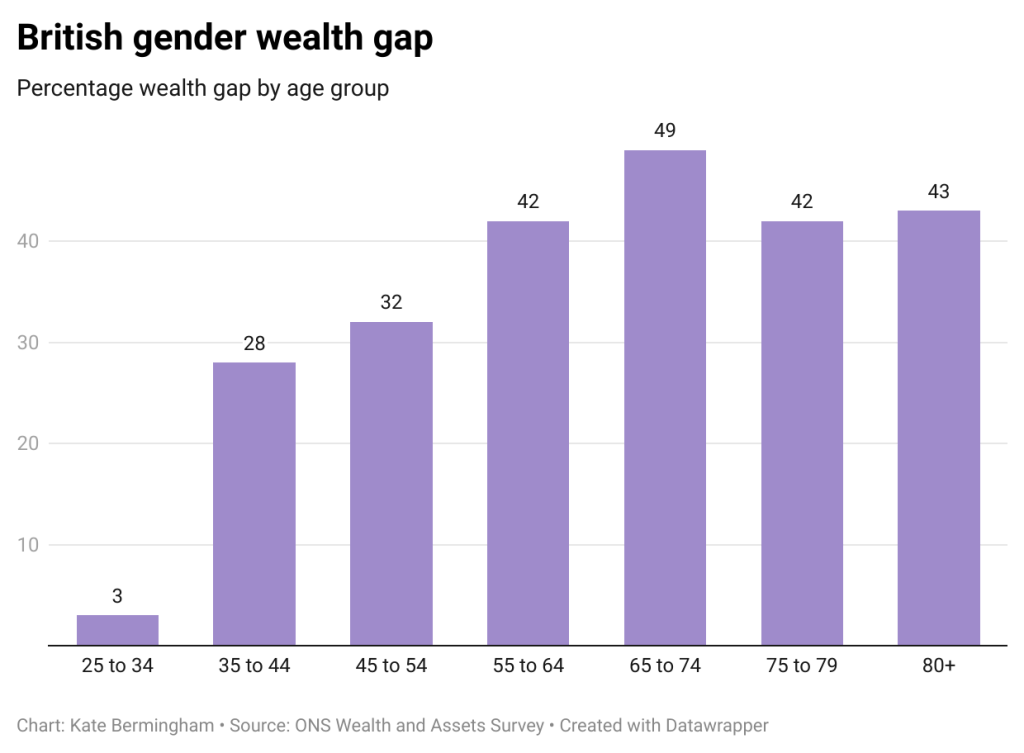
The gender wealth gap varies significantly throughout a woman’s life. For women in their 20s the average gender wealth gap is negligible, but by age 65 it increases to 49%.
What about pensions and investments?
The gender pension gap is 90%. Men have an average private pension wealth of £83,879 more than women. For men, their main source of wealth is their private pension. In contrast, for women more than 50% of their wealth comes from property and other assets (e.g. possessions and vehicles) which are usually shared with other members of their household.
The gap between the average value of UK shares held by men and women is £3,974, a difference of 177%.
Why does the gender wealth gap exist?
There are multiple factors contributing to the gender wealth gap, and each woman’s experience will be unique to them, but there are some key structural norms that reinforce the gender wealth gap over time.
The gender pay gap means that women have less money available to save, invest and purchase assets. Women are less likely than men to feel confident about investing. Workplace issues such as sexual harassment, inflexible working conditions and maternity discrimination also affect women’s ability to progress in their careers.
The wealth gap increases significantly as women reach early middle age, and women reaching retirement age face a gender wealth gap of 49%. This correlates with the time period when women often leave the workforce or reduce their working hours to focus on raising children and/or caring for older or disabled relatives.
Women are more likely than men to live with a disability that limits their ability to work, 69% of women say period pain has had a negative impact on their work, and one in ten women experiencing the menopause have quit their job due to their symptoms.
Women’s health services are chronically underfunded, despite research suggesting that an additional £1 invested in obstetrics and gynaecology services per woman in England could generate an estimated £319 million return to the economy (£11 for every £1 invested).
Why does the government not measure the gender wealth gap?
Confusingly, the government did publish the overall gender wealth gap in a one-off report on the distribution of wealth by characteristics in 2022, when they found a gender wealth gap of £101,000 for the period 2018-20. However, they do not publish a dedicated statistical bulletin on the gender wealth gap (as they do each year for the gender pay gap), and in 2025 they published the latest biannual Wealth and Assets survey results without any gendered analysis.
Neither the previous Conservative government, nor the current Labour administration, seem particularly concerned about the gender wealth gap. Presumably if they were, they would (as a bare minimum) ask the Office for National Statistics to measure it and publish the findings.
The gender wealth gap reveals that our economy leaves women (particularly female pensioners) disproportionately exposed to financial hardship, and doesn’t sufficiently value the unpaid labour that women contribute to society.
How can the gender wealth gap be reduced?
Reducing the gender wealth gap would require a number of reforms in the workplace, the broader economy, and in our homes and personal relationships.
For example…
- Closing the gender pay gap
- Addressing gender discrimination in the workplace
- Reducing barriers to workforce participation, e.g. normalising flexible working
- Challenging traditional gender norms in the home
- Investing in social infrastructure, e.g. childcare, etc.
- Increasing investment in women’s healthcare
- Making affordable housing more accessible for women
- Introducing wealth taxes to reduce extremes of wealth inequality and boost investment in public services.
 Living under Patriarchy