What is the right to social security?
The human right to social security is set out in article 9 of the International Covenant on Economic, Social and Cultural Rights (1966). It is also recognised in the Universal Declaration of Human Rights 1948), and other treaties and legal instruments such as the Convention on the Rights of the Child (1989), the European Social Charter (1961) and International Labour Organisation Convention No. 102 (1952).
The UN Committee on Economic, Social and Cultural Rights, which monitors state compliance with the ICESCR, defines the right to social security as protection from income loss due to sickness, disability, unemployment, and other factors. The right to social security is integral to reducing poverty, promoting social inclusion and ensuring basic needs – such as healthcare, food and housing – are met.
In 2007, the Committee issued General Comment 19, which clarified that states must ensure social security provision meets the following criteria:
- Availability: welfare or social security payments must be available and in place to ensure that individuals are protected from social risks, such as poverty.
- Adequacy: social security schemes must ensure an adequate standard of living to protect dignity and human rights.
- Accessibility: social security payment systems must be accessible, transparent and non-discriminatory.
Is the UK required, under international law, to respect the right to social security?
Yes. The International Covenant on Economic, Social and Cultural Rights is one of three treaties which comprise the International Bill of Rights. After the horrors of World War Two, these defining legal instruments laid the foundation for a new, human rights-respecting world, and state compliance with all of these obligations is key to achieving that ambition.
The UK signed and ratified the ICESCR in 1976. When a state ratifies a human rights treaty, this means it is bound, under international law, to respect the rights and meet the obligations set out in that treaty.
However, nearly five decades later, the UK has failed in its duty to incorporate these rights into domestic law (it has, however, incorporated civil and political rights, under the Human Rights Act, 1998). This means that individuals who experience violations of their social and economic rights in the UK have no legal recourse. As a result, millions of marginalised people in the UK cannot access justice for violations of their right to social security, or other related social and economic rights.
How are UK women disproportionately affected by state failures to protect their right to social security?
According to a new briefing by the Women’s Budget Group, women as a group continue to be disadvantaged by the UK economy relative to men in a number of ways, including:
- Women complete significantly more unpaid domestic work than men.
- Women’s employment rate is 72%, compared to 78% for men, and 70% of part-time workers are women.
- Women are over-represented in low-paid segments of the labour market, holding 60% of all jobs paid below the real living wage.
As a result, women’s earnings lag behind those of men, which means women are more likely to be living in poverty, and more likely to rely on social security payments. 58% of Universal Credit claimants are women, and 42% of single parent households live in poverty (89% of single parent households are led by a single mother). 58% of individuals claiming disability benefit are women.
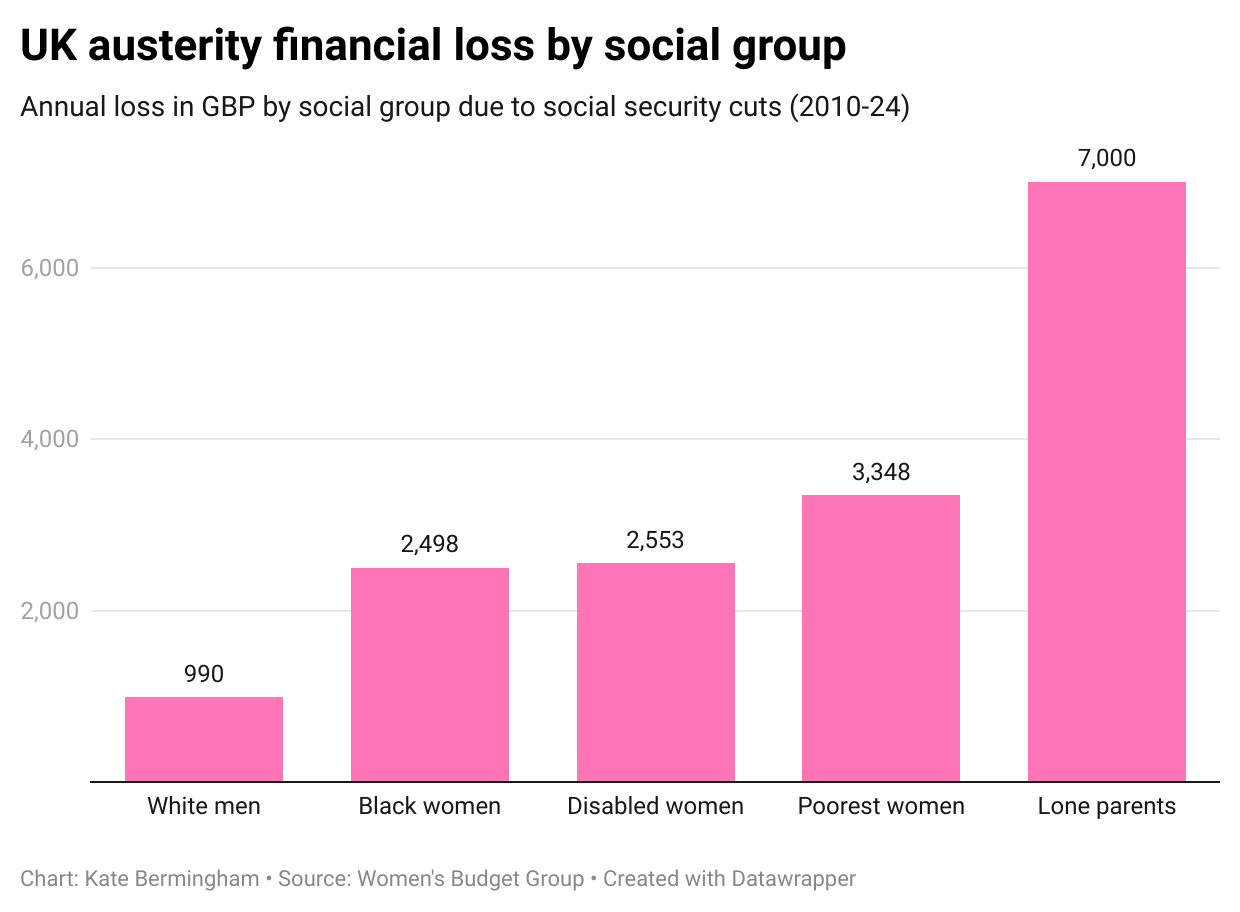
Last year, the Women’s Budget Group carried out an intersectional analysis of the impact of austerity measures from 2010 to 2024. Their analysis found that white men (across all income deciles) lost on average £990 per year as a result of austerity measures. Women in the lowest income decile (i.e. the poorest) lost on average £3,348 per year, and lone parents (89% of whom are women) lost on average nearly £7,000 per year. This meant that the average single mother was hit more than seven times harder by social security cuts than the average white man.
How do women who rely on Universal Credit feel about the system?
Amnesty UK’s recent report on this issue, entitled Social Insecurity, sets out the hardship and indignity women who rely on state benefits typically experience.
Laura*, told Amnesty UK: “They told me to go in for an assessment, and my baby had passed away… not even two days before… And they were like, well if you need the money, you will come in. It’s not my fault your baby is dead.”
Penelope*, a single mother aged 39, said: “The hardest thing about the social security system is the uncertainty and insecurity around it all. It was very mentally challenging to not know when or how much my payments would be. I lived in fear of uploading the wrong information and having my benefits cancelled again.
The worst part is the feeling like you have no control over anything. You always feel insecure… The stigma is real, navigating the system only amplifies it, making an already difficult situation even harder… It creates a feeling that you aren’t deserving or worthy.”
*Names have been changed to protect privacy.
How can this be fixed?
In their report, Amnesty UK makes the following recommendations for three key institutions.
UK Government
- Establish a Statutory Social Security Commission
- Fiscal measures to support reform
- Human rights and legal framework reform.
Department for Work and Pensions
- Address harmful policy measures
- Ensure meaningful reform through consultation and accountability
- Create a UK Charter for Social Security Rights
- Embed claimant participation and oversight
- Reform the legislation and process for setting and uprating social security levels
- End the sanctions regime.
UK Parliament
- Human rights oversight and accountability
- Independent inquiry into Jobcentre practices.
 Living under Patriarchy