Organisations supporting women in the criminal justice system are facing an average funding shortfall of £756,826, according to new research from the Women’s Budget Group and the National Women’s Justice Coalition. This is despite the Justice Secretary’s pledge to divert women away from the prison system and towards community-based solutions.
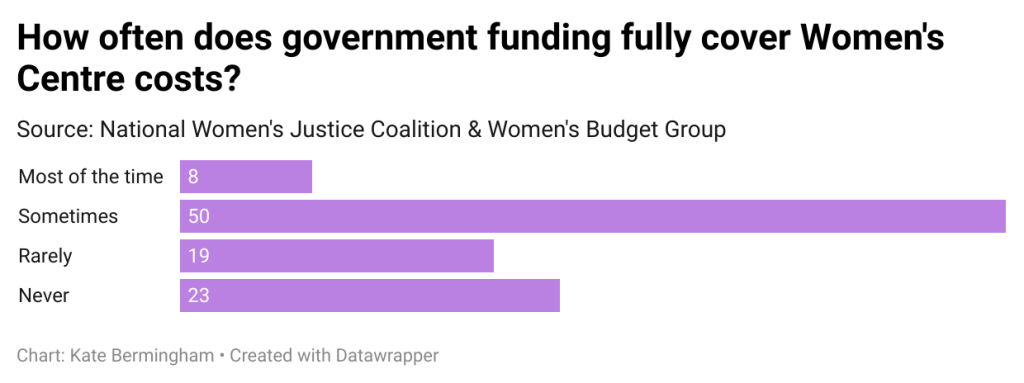
77% of the 26 Women’s Centres that make up the National Women’s Justice Coalition say they have not yet been able to secure funding to cover their costs for this financial year. Unless this is rectified they will be unable to deliver the Women’s Centre Model, which is designed to support and rehabilitate women in the criminal justice system. Just 8% of Women’s Centres said that statutory funding allows for full cost recovery ‘most of the time’, and 23% said it never does.
As set out in Baroness Corsten’s seminal report in 2007 on women’s experiences in the criminal justice system: the UK prison estate is wholly unsuitable for vulnerable women. The issues outlined in the Corsten report nearly two decades ago – women being imprisoned for minor, non-violent offences, prison overcrowding, women not receiving appropriate care for mental illness and addiction, high rates of self-harm, pregnant women not receiving appropriate care, lack of rehabilitation – continue to harm women today. Women make up just 5% of the prison population, and the Corsten Report called for a “fundamental re-thinking” in how female prisoners are treated.
The Women’s Centre Model is designed to provide holistic support based on women’s needs, and is underpinned by strong evidence: an analysis comparing community-based court orders for women to short custodial sentences found a much lower reoffending rate for women on community orders (30% vs 73%). It is also hugely cost effective: research by the New Economics Foundation found that £14 of value was generated for every £1 of public funding invested in women’s centres.
Women’s prison places cost significantly more per year than community-based support at a Women’s Centre: £78,996 versus £1,223 – £4,125.
The UK has one of the highest rates of women’s imprisonment in western Europe, and the female prison population in England and Wales has doubled since 1993. Women are more likely than men to be sent to prison for short sentences – 69% serve sentences less than 12 months, compared to 52% of men – and for non-violent offences.
Women in the criminal justice system have a distinct set of needs, which differs from the male prison population:
- 59% of women in prison report that they have a mental health problem
- The self-harm rate in the women’s prison estate is seven time higher than for men in prison
- 57% have experienced domestic abuse
- 55% of women in prison have children (only 5% of children remain in the family home after their mother is imprisoned).
Dr Sara Reis, Deputy Director of the Women’s Budget Group, said:
“Women’s interaction with the criminal justice system is both a cause and a consequence of women’s economic inequality.
Women’s centres are doing extraordinary work to support women untangle the complex roots of offending, while being more cost-effective than sending women to prison. Yet, they are forced to operate on a knife-edge, worrying if they can keep their doors open.”
The Women’s Budget Group and the National Women’s Justice Coalition are calling for a sustainable, long-term funding settlement from the government to protect the future of Women’s Centres.
 Living under Patriarchy